
 Eng
Eng  Тоҷ
Тоҷ  Рус
Рус 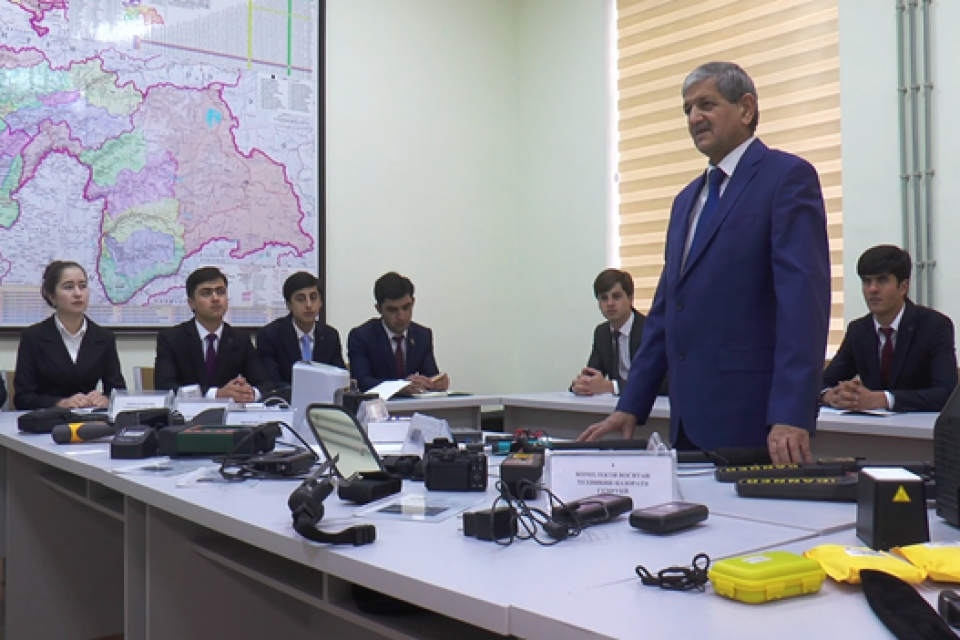
Customs Laboratory
Customs Laboratory of the Tajik State University of Finance and Economics
On December 20, 2022, with the participation of the Founder of Peace and National Unity – Leader of the Nation, President of the Republic of Tajikistan, His Excellency Emomali Rahmon, and the Chairman of the National Assembly of the Supreme Assembly of the Republic of Tajikistan, Mayor of Dushanbe, His Excellency Rustam Emomali, the new academic building of the University, including the Customs Laboratory, was officially inaugurated.
It is a matter of great pride that this day became a historic event for our University. For the first time, the Head of the Tajik state visited our University. On this unforgettable day, the Customs Laboratory, which meets modern international standards, was inaugurated for the first time among higher education institutions of our country with the direct participation of the Leader of the Nation, President of the Republic of Tajikistan, His Excellency Emomali Rahmon.
Following the instructions and directives of the Founder of Peace and National Unity – Leader of the Nation, President of the Republic of Tajikistan, His Excellency Emomali Rahmon, the leadership of the Tajik State University of Finance and Economics established a customs laboratory that meets international standards in order to align theory with practice in the teaching process. To equip and supply the laboratory, the University, with the support of the “Higher Education Development Project” of the Ministry of Education and Science of the Republic of Tajikistan, acquired several unique technical devices for customs control, which have no analogues.
The Customs Laboratory consists of two sections.
The first section represents the structure of a border customs checkpoint with its infrastructure, including the customs control area, green and red corridors with corresponding signs (in Tajik, Russian, and English), a UItraScan S1000 metal detector for identifying metallic objects, and an Eastimage X-ray scanner (introscope) for inspecting hand luggage (without opening it) during customs clearance and customs control of passengers and their belongings.
This section provides training on the procedures of customs clearance and customs control of passengers and their luggage in accordance with the regulatory legal acts of the Republic of Tajikistan and international standards, using technical means of customs control, as well as customs declaration forms used at border customs checkpoints. Such customs clearance and control procedures for passengers and luggage, in accordance with international conventions, are uniform across all countries of the world.
The second section of the Customs Laboratory focuses on studying the structure and methods of using technical means of customs control at border customs checkpoints.
Currently, the Customs Laboratory is equipped with the following technical devices, the structure and operation of which students study in detail. These include:
-
technical customs control equipment: UItraScan S1000 metal detector;
-
Eastimage EI-5030 X-ray scanner (introscope);
-
GARRETT SUPER SCANNER V handheld metal detector;
-
DME-03 detector for identifying precious metals and their alloys;
-
special inspection kit for vehicles — KDI-2M (Gastrol-P);
-
PRESIDIUM Gem Tester II gemstone detector;
-
ST-V100 currency detector.
It is a matter of pride that among higher educational institutions in the country, this is the first Customs Laboratory that meets modern international standards.
According to clauses 10 and 11 of the Action Plan of the Executive Office of the President of the Republic of Tajikistan dated January 5, 2023, No. 24/10-11, “On the implementation of the instructions and orders of the President of the Republic of Tajikistan, Leader of the Nation, His Excellency Emomali Rahmon, given during the visit to the facilities of Dushanbe City on December 20, 2022,” the Customs Service under the Government of the Republic of Tajikistan has been instructed to:
-
establish cooperation with the Tajik State University of Finance and Economics for the training of sectoral specialists, their selection, and recruitment;
-
maintain constant supervision over the activities of the Customs Laboratory in conducting practical classes, introducing effective methods into the educational process, organizing scientific research, and creating scientific groups.
Taking into account the instructions of the Leader of the Nation, a number of technical customs-control devices were transferred from the balance of the Customs Service of the Republic of Tajikistan to the balance of the university (according to the decision of the Chairman of the State Committee on Investments and State Property Management of the Republic of Tajikistan dated May 29, 2023, No. 267).
In particular, the following equipment was transferred:
-
a ST-30 set for detecting smuggling;
-
MKS-RM1410R dosimeter-radiometer;
-
a surveillance (inspection) camera;
-
a training and demonstration kit on dual-use goods;
-
devices and instruments for detecting and measuring ionizing radiation — ISP-RM1704M signal-measuring device (2 units);
-
a refrigerant-homogenizer device.
Every year, second-year students (full-time and part-time) of the following specialties:
-
1-960101 — Customs Service,
-
1-96010101 — Legal Support of Customs Activity,
-
1-96010102 — Economic Support of Customs Activity,
-
1-96010103 — Economic Security,
-
125010409 — Finance and Control in the Field of Customs Activity,
undertake their academic internship in the Customs Laboratory according to the schedule approved by the First Vice-Rector and the Vice-Rector for Academic Affairs.
During the practical classes, students become familiar with the available technical equipment, the rules of its operation, forms of customs control, and other aspects of customs authorities’ activities.
This laboratory enables students to apply their theoretical knowledge in practice, thoroughly study the work of customs authorities, and prepare for their future careers as qualified specialists.
Responsible for the Customs Laboratory: Associate Professor Mirakov Q. M.
